Ephemerratic - 10/25 - Independent travel blog with stories, travel guides, photos, travel art, and local food
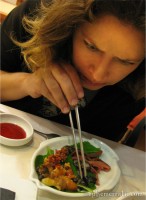
Eating live animals in South Korea | Photo by Lauren Girardin
We skip willy-nilly through the time-space continuum over on Matador Network, who just published my new travel story about eating live animals in South Korea. Here’s a taste:
My chopsticks finally aim towards the last untried morsels, a substance that can be generously described as resembling chunks of slug. Its glossy, soft flesh is a mottled mix of khaki green, deep brown, mustard yellow, and blue-gray, combined to make a surface both artful and repulsive.
If I saw this beast in my kitchen at home, I’d wonder how it had oozed its way inside from the backyard. But, I’m determined to try anything once, especially if it’s already on the table in front of me. With a deep breath and a deeper sigh, I pick up one of the smaller chunks—
And it moves.
The comments are worth reading too, filled with commiseration and even anti-gagging tips. Thanks to all the complete strangers that have commented on the post. I’d love to read your comment on Matador.
>> Read the rest of the story on MatadorAbroad.com
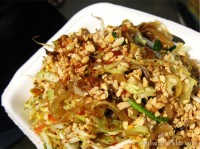
Thai street food 101: pad thai | Photo by Lauren Girardin
You don’t get to see or do much when you get kicked out of a country. So most of our YEH-MEH-NAHs are for things within a few blocks of our hostels, the immigration office, and Pantip Plaza. That’s right – we didn’t see a single one of Bangkok‘s sites. But we did eat!
Read more ➙

Wat Arun from a commuter boat | Photo by Lauren Girardin
Though Todd and I actually had two nights in Bangkok before we were kicked out of Thailand, I still felt justified in singing Murray Heads’ song, One Night In Bangkok
to comfort myself. When you’re booted from a country, sometimes a sing-along is all you have.
Read more ➙
Todd and I spent only a couple days each in Sukhothai and Ayuthaya, Thailand, and a lot of that time was spent at the Buddhist sites. Even so, we happened upon a few non-touristy gems and plenty of predictable mediocrity.
The Ratings Explained:
- YEH – Like flying trans-Pacific with an adjacent empty seat. YEHs are as good as you can get, especially for your backpacker buck, although sometimes a YEH is only relative to the other worse options in town.
- MEH – Like driving a economy rental car to an obligatory wedding. An intense level of indifference best describes a MEH experience. Got time to kill? Dong to burn? Checked your email? Sure, fine, do it. Whatever.
- NAH – Like taking an overnight bus ride in any country where chickens outnumber people. NAHs are worth avoiding at all costs. Likely to cause aggravation, frustration, or a need for Cipro.
Read more ➙
Last night’s travel art show at cellSpace was a blast. It was interesting to see people’s reactions to art created on such a long trip, and also to hear their enthusiasm about travel.
Lauren and I also finally got to meet Edward Hasbrouck, author of my favorite book that I read to prepare for our round-the world trip, The Practical Nomad: How to Travel Around the World. He stopped by the show and he and Lauren chatted for hours while I talked with people who came to see the art.
Though they were up on the wall last night, it’s time for the drawings I made in Thailand to make their virtual appearance. From a distance, elephants just look gray. As you get closer though, you can see the complexity and texture of their skin. I used layers of white paint and many colors in this drawing of an elephant during feeding time at Elephant Nature Park.
Hungry Elephant$30,
marker on paper, 6″ x 4″
Read more ➙
Todd’s art don’t stop anywhere, even when traveling around the world. He drew constantly as we moved, sketching pandas, temples, Buddhas, rivers, sunsets, elephants, skulls, landscapes, people, famous ruins, tuk tuks, musicians, and the occasional leg of jamón.
The travel drawings will be on shown (live, as opposed to online) for the first time this Thursday, November 5, at 7:00pm at Spacecraft, the monthly group show at CELLspace in San Francisco. Click for more info, address, and to shout out that you’re coming.
The show also includes creations by CELLspace studio artists, DJ beats, live performers, wine and cheese (it is an art show) and the unexpected. We hope to see you there!
This week only, the drawings are discounted, but only until the show is over. Art that’s normally $15 is on sale for $10; drawings normally $65 can be yours for $40 (shipping not included).
First, click here to check out the travel art.Then, just email Todd at

with the title(s) of what you want and your mailing address. He’ll reply with payment instructions. First come, first served. Remember, shipping is not included, but instead of delivery, you could also pick it up at CELLspace on Thursday.

Buddha in a field of columns | Photo by Lauren Girardin
I was curious about the literal translation of tom yum goong, which I understood simply as Thai spicy prawn soup based on what was in my bowl. Goong was easy: “prawn,” which our friend Crissy, the marine biologist, and other authorities will tell you to avoid eating in Asia, because of industry-related environmental horrors. Tom, was a little harder to unearth, but near enough means “boiled” or “soup.” So far, my understanding seems spot on.
Yum, however, proved more mysterious, defying a succinct one-word-for-another translation into English when soup is concerned. The most tantalizing meaning of yum is the balanced mix of the four Thai flavors – sweet, salty, sour, and spicy.
Yum, a balancing act. How many of my travel experiences can be metaphored by this bowl of soup? Even my eating of the soup is itself an example of a balancing act. Because of eco-guilt, I don’t normally eat prawns, but over such a long time in Asia, one inevitably, occasionally fails miserably at ethical commitments, especially involving food. My behavior (and misbehavior) is a balance of desire, logic, willpower, and circumstance.
Is looking for meaning in a bowl of soup a clue that I’ve been traveling too long? Next thing you know I’ll compose haiku about the symbolic beauty of rice, or to be even more travel blog cliché about it, I’ll write a post titled, “The Top Ten Asian Food Metaphors.”
Soup aside, the southbound road awaits.
Read more ➙
Like is true for most visitors, our week in Chiang Mai, Thailand was filled with many all-day activities. When we weren’t feeding elephants or nearly blinding ourselves with chili, we wandered from wat to wat, stopping to eat as often as we could. Nearly everything was excellent, though a few stinkers popped up in Chiang Mai.
The Ratings Explained:
YEH Good to great, though sometimes only relative to the other options in town. ! = we wanted more.
MEH An intense level of indifference. It probably won’t suck, but it won’t impress either.
NAH Likely to cause sadness, frustration, wallet-emptying, or a raging need for Cipro. Avoid.
Read more ➙
We’re trying something new in this post – larger images! We hope you like them. Of course, you can still check out all our Chiang Mai photos in our slide show. And now the story…

Webbigail’s a Buddha groupie | Photo by Lauren Girardin
There is an overriding theme to our week in Chiang Mai, Thailand. Usually you’ll hear platitudes like beautiful, historic, cultural, or fascinating used to describe this Thai metropolis. Chiang Mai is all of those things. Like any major city, at times it’s also touristy, skeezy, and polluted. But, but most of all, Chiang Mai is just plain weird.
Read more ➙

Under the watchful eye of an elephant | Photo by Lauren Girardin
It’s near impossible to visit Chiang Mai, Thailand and not spend every day checking something off the traveler’s list of must-dos. It seems as lazy and cliché as a Snuggie to keep doing what everyone else does – whether it’s catching a muay thai match or taking a cooking class – but it’s all been so much fun. There’s a reason these are well-trod tourist paths. Todd and I are content to be part of the herd.
Before leaving on this round-the-world trip, most friend’s tips for Thailand included that we go on an elephant trek. My do-gooder super-ego immediately started grumbling like Marge Simpson, leery of an animal-dependent tourist attraction that’s not a preserve or national park.
So I picked up the Fate of the Elephant by Douglas Chadwick. Though a bit old, published in 1994, it’s an extraordinary book filled with cautionary tales about ivory trade, poaching, logging servitude, and the no-one-wins conflict between struggling farmers and the ravenous, habitat-deprived elephants that destroy crops. Chadwick rarely preaches, letting his stories and research speak for themselves. Reading Fate of the Elephant convinced me that there had to be something more responsible than a trek for my Thai elephant encounter.
Read more ➙